How to work out class positions on a report card (with ties)
Updated 24 October 2026
The position in class is the number parents ask about most, and the one that causes the most arguments when it is wrong. Here is how to work it out fairly.
1. Choose what to rank by
- By average (or total): the highest average is 1st. Simple, and it uses every subject.
- By aggregate: the lowest aggregate is 1st, because fewer points is better. Many schools use the average to break a tie between equal aggregates.
Pick one, write it down, and use it for every class in the same level, every term.
2. Ties share a position
Learners with exactly the same result share the same position, and the next learner skips the places they took. This is called standard competition ranking:
| Learner | Average | Position |
|---|---|---|
| Nakato Sarah | 86.4 | 1st |
| Okello Brian | 84.2 | 2nd |
| Achieng Grace | 84.2 | 2nd |
| Mugisha Isaac | 79.0 | 4th |
Nobody is 3rd: two learners share 2nd, so the next one is 4th. Write it as “2nd / 48”, so parents also see the class size.
3. Round the same way for everyone
Decide how many decimal places you keep for the average before you rank. Two learners with 84.24 and 84.16 are both 84.2 when rounded to one place, so they tie. If you rank on the unrounded numbers, parents will see two equal averages with different positions, and you will have to explain it.
4. Learners with missing marks
A learner who missed an exam has fewer marks, so their total is not comparable. Most schools either leave such learners without a position until the mark comes in, or show the position with a note. Do not quietly treat a missing mark as zero: a learner who was sick is then ranked below a learner who failed.
5. Streams
With P.6 Blue and P.6 Red, decide whether the position is within the stream (out of 40) or across the whole class (out of 80). Many schools show the stream position on the card and keep the whole-class position for the staff.
6. Nursery
Most nursery schools leave positions off the card entirely. Ranking children of three to six years old helps nobody.
Questions schools ask
Why do two learners with the same average get different positions?
Usually because the average was rounded for the card but the ranking used the unrounded numbers. Rank on the same rounded value you print, and equal averages share a position.
Is it 1, 2, 2, 3 or 1, 2, 2, 4?
Most schools use 1, 2, 2, 4: two learners share 2nd, and the next learner is 4th because three learners are ahead of them.
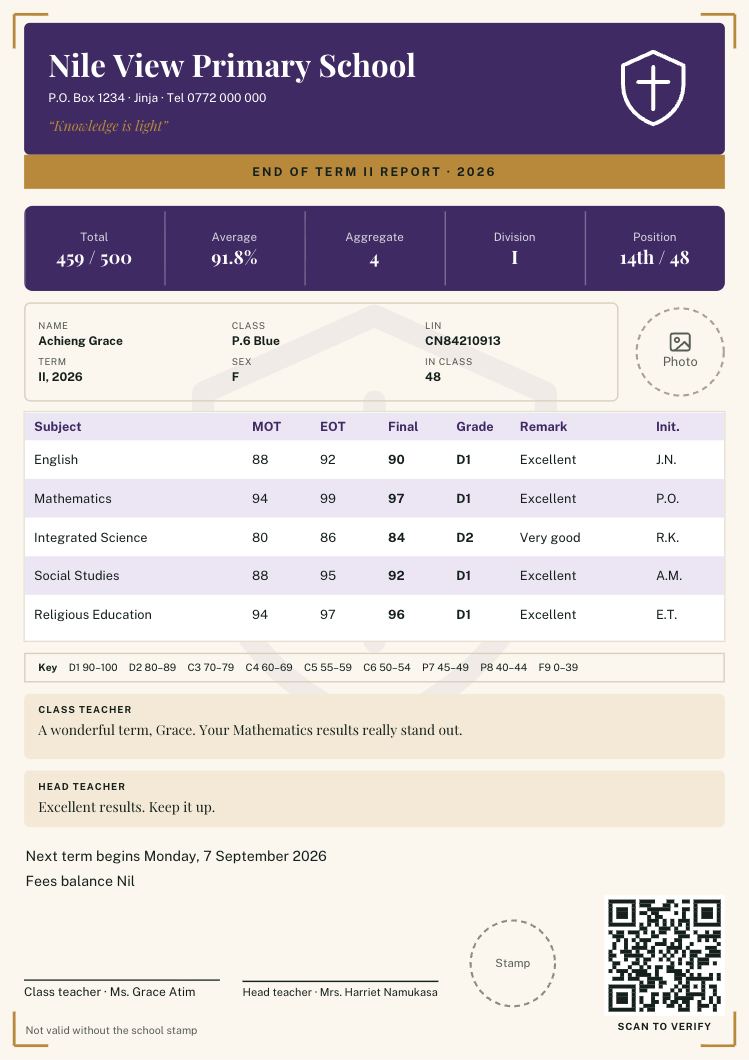
Positions without the arguments
Report Card Studio ranks every class by your school’s rule, shares positions on ties and says plainly which learners are missing marks. You can also print the class in position order. Free until you print.
Questions? Call or WhatsApp 0784 150 327, or email [email protected].