How to read your child’s report card: a guide for parents
Updated 24 October 2026
Report cards are full of numbers and letters. This short guide explains what each part means, so you can see how your child is doing and what to talk about with their teachers.
The marks
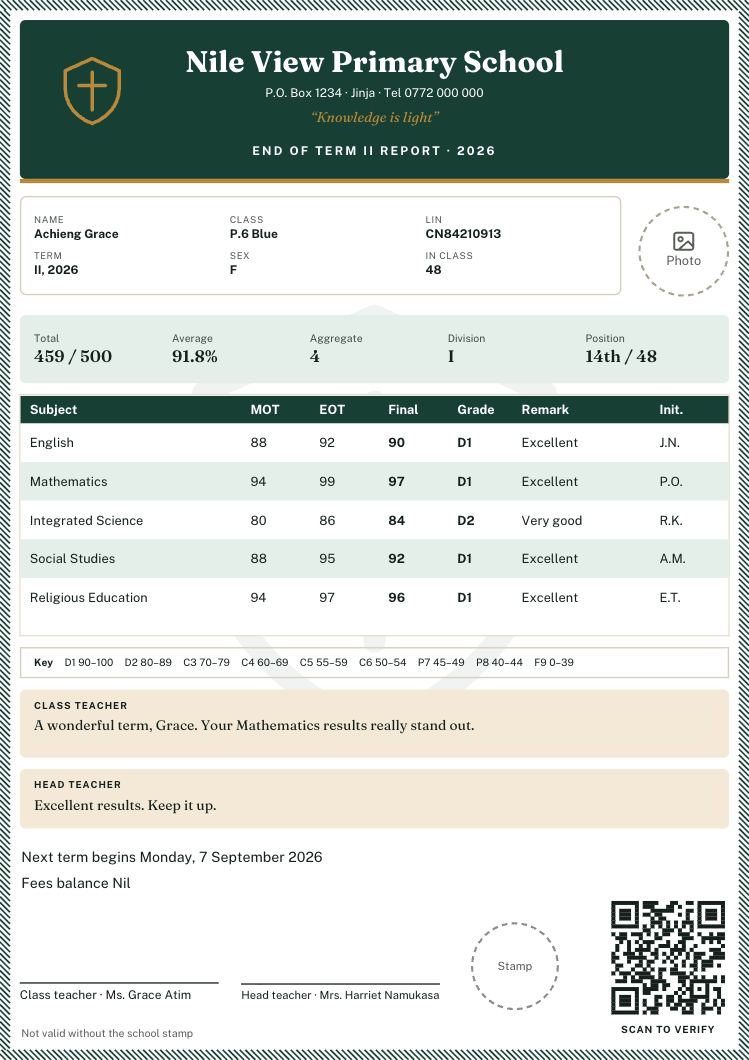
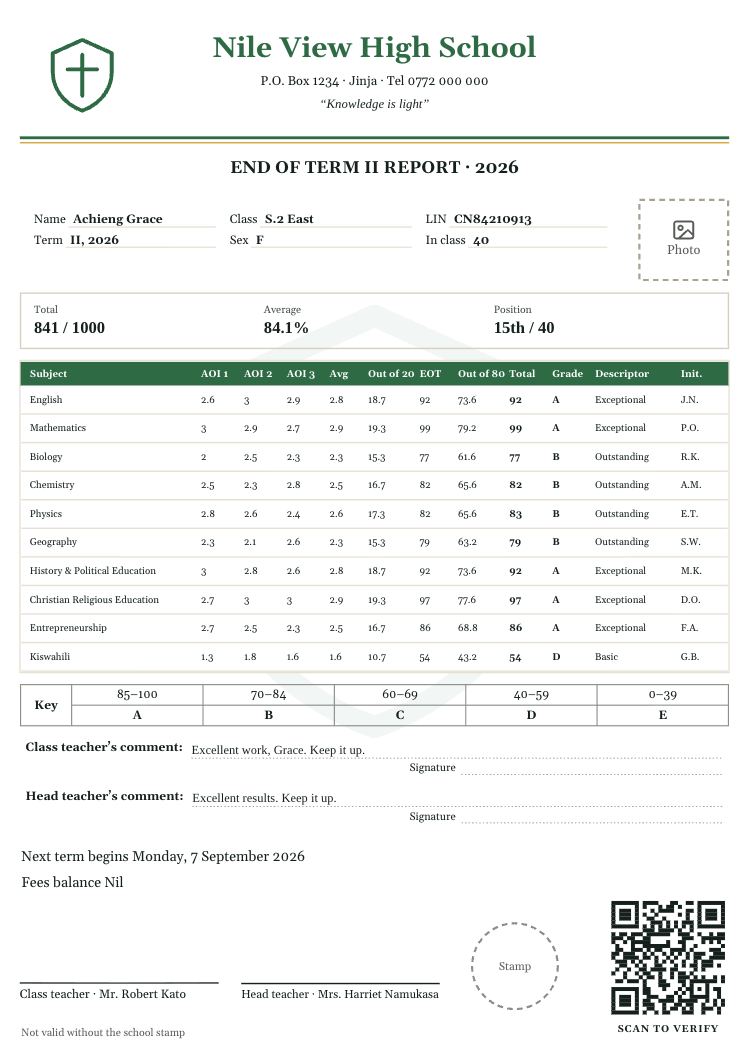
Most cards show the marks from each exam this term: beginning of term (BOT), mid-term (MOT) and end of term (EOT), and a final mark that combines them. The final mark is the one that counts.
The grade
In primary, and in many secondary schools, grades run from D1 (the best) to F9. On the new lower secondary curriculum, grades run from A (Exceptional) to E (Elementary). The remark beside the grade says the same thing in words.
The aggregate
Each D1 to F9 grade has points: D1 is 1 point, D2 is 2, and so on up to F9 with 9. The aggregate adds up the points of the best subjects, usually four in primary. A lower aggregate is better. In primary, 4 is the best possible.
The division
The division comes from the aggregate: Division I is the best, then II, III and IV, and U means ungraded. Each school sets its own ranges.
The position
“5th / 48” means your child came fifth in a class of 48. Two children with the same result share a position.
The comments
The class teacher and head teacher write a short comment. Look for what went well and what to work on, and talk about both with your child.
Questions to ask the teacher
- Which subject needs the most help, and how can we help at home?
- Is my child’s result better or worse than last term, and why?
- Are there any marks missing?
Is the card genuine?
Some cards have a QR code. Scanning it with a phone opens a page that confirms the card was issued by the school.
For schools: clear cards parents understand
Report Card Studio helps schools make report cards with the results in one clear line, a grading key and comments for every learner.
Questions? Call or WhatsApp 0784 150 327, or email [email protected].