Learner data and the Data Protection and Privacy Act: a guide for schools
Updated 24 October 2026
Schools hold a lot of personal data about children: names, dates of birth, photos, marks, health notes and parents’ contacts. Uganda’s Data Protection and Privacy Act, 2019 sets rules for handling it. This is a plain-word starting point, not legal advice.
Good practice for learners’ data
- Collect only what you need. If the report card does not need a learner’s date of birth or home address, the report card system should not ask for it.
- Photos with consent. Print a learner’s photo on a card only when a parent has agreed, and record that they agreed.
- Not everyone needs to see everything. A class teacher needs their own class, not the whole school. A subject teacher needs their own subject’s marks.
- Log changes to marks. Know who changed which mark, and when.
- Keep it safe. Passwords, not shared accounts; backups; and care with spreadsheets sent around on WhatsApp or flash disks.
- Keep it only as long as needed, and delete it properly when a school stops using a system.
Choosing software
Before putting learners’ data into any school system, ask:
- Can another school ever see our data?
- Can each staff member see only what their role needs?
- Can we download all our data, and delete it?
- Where is the data kept, and is it encrypted?
Where to learn more
The Personal Data Protection Office (PDPO), under NITA-U, oversees the Act and publishes guidance, including on registering as a data collector or processor. Check their current requirements for schools.
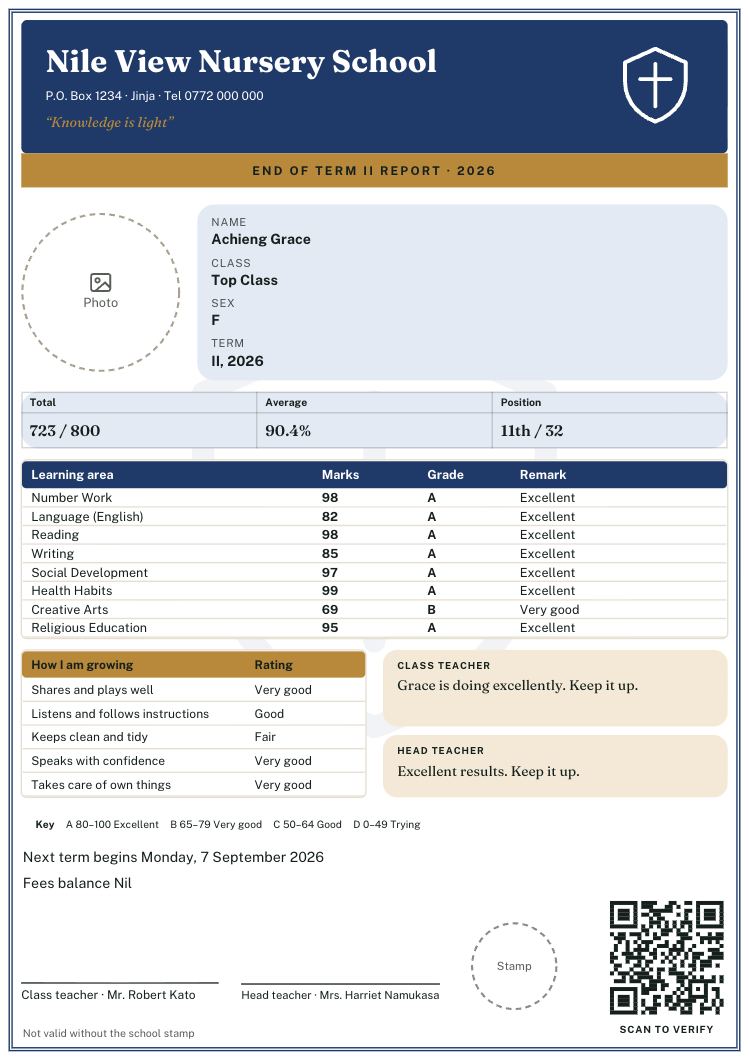
Built with learners’ privacy in mind
Report Card Studio keeps only what the card needs, prints photos only with recorded consent, keeps each school’s data apart, logs every change to a mark, and lets you download or delete your data at any time.
Questions? Call or WhatsApp 0784 150 327, or email [email protected].