Primary school report card format in Uganda (P.1 to P.7)
Updated 24 October 2026
A primary report card has one job: to tell a parent, in a minute, how their child did this term and what to work on next. Here is what to put on it, in the order parents read it.
1. The school at the top
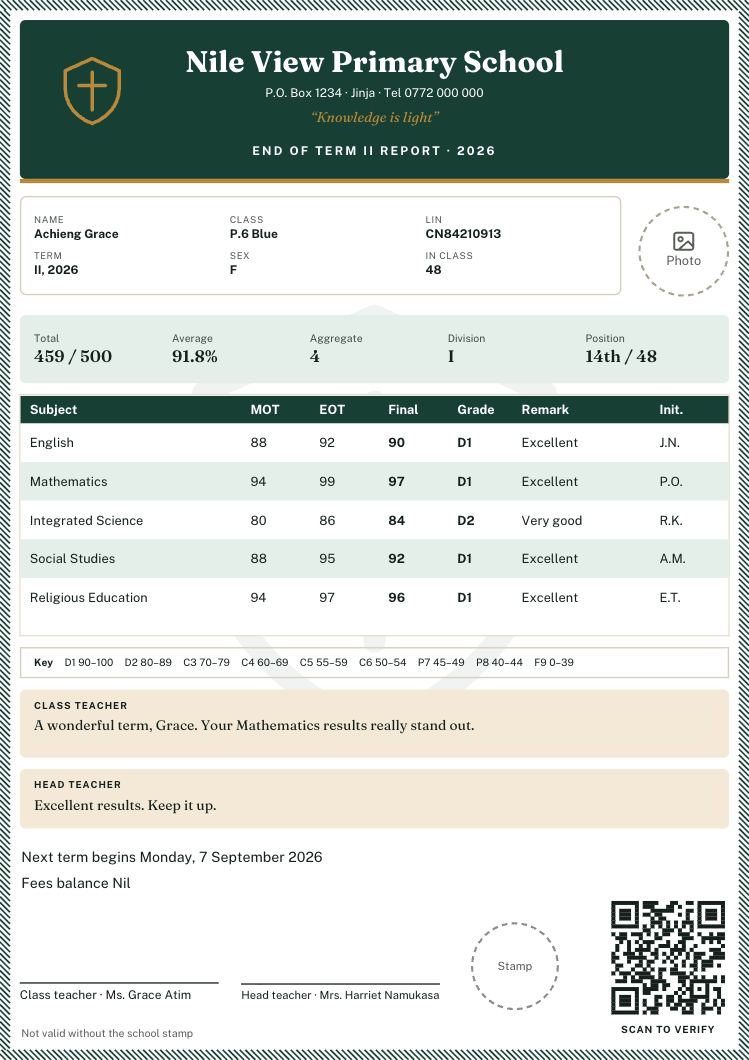
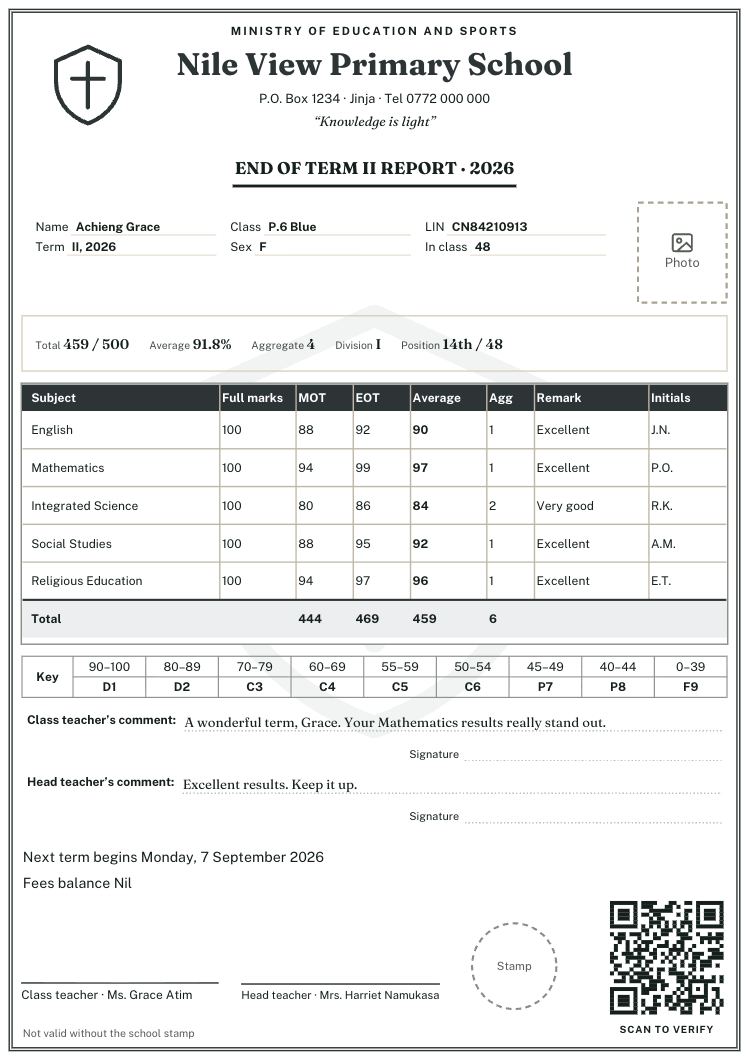
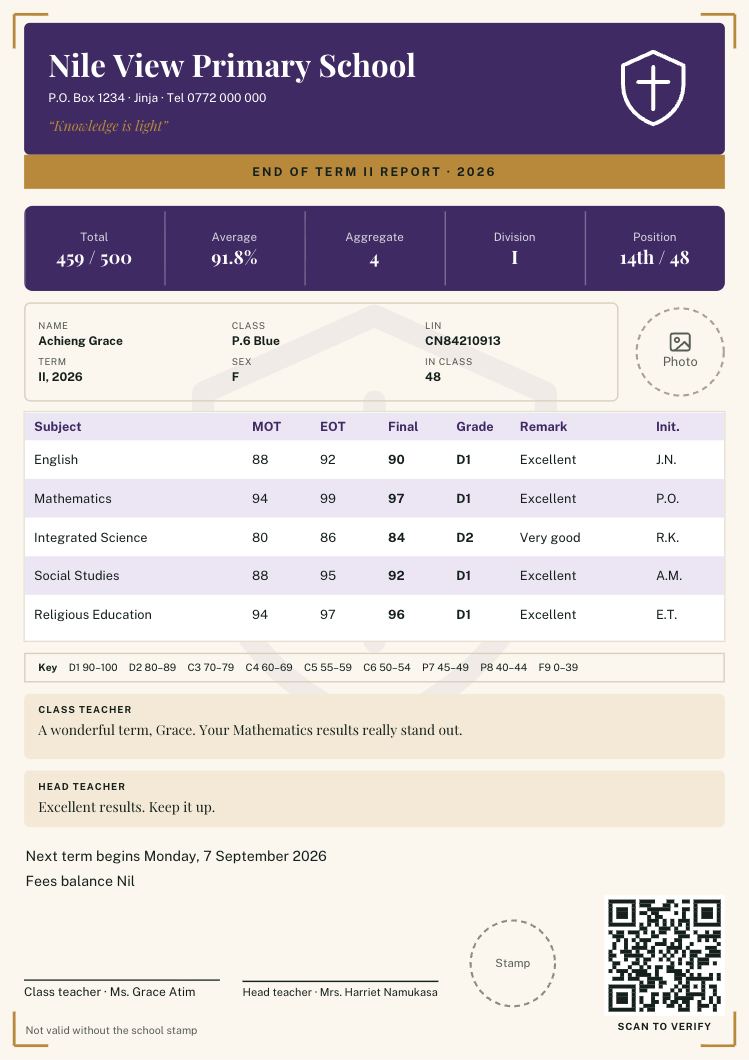
The school’s name, crest, motto, address and phone number, and the title of the report: for example “End of Term II Report 2026”. Parents keep cards for years, so the year and term matter.
2. The learner’s details
Name (surname first, as on the class list), class and stream (for example P.6 Blue), sex, LIN if your school records it, and the number of learners in the class. A photo is a nice touch, but print it only for learners whose parents agreed.
3. The marks table
One row for each subject. In upper primary the usual subjects are English, Mathematics, Science and Social Studies, often with Religious Education. Lower primary schools often report the learning areas of the thematic curriculum instead. Typical columns:
- Exam marks: beginning of term (BOT), mid-term (MOT) and end of term (EOT), or only the ones your school sets.
- Final mark: the exams combined by your school’s weights, for example 40% MOT and 60% EOT. See how to combine BOT, MOT and EOT.
- Grade and points: D1 to F9, where D1 is 1 point and F9 is 9.
- Remark: a word or two for the grade, such as Excellent, Very good or Fair.
- Teacher’s initials: so parents know who teaches the subject.
4. The results summary
Total marks, average, aggregate (the points of the best four subjects), division and position in class. Keep it to one line or one small box: these are the numbers parents look for first. How aggregates and divisions are worked out →
5. The grading key
A small table of your grade bands (90–100 D1, 80–89 D2 and so on), so a parent can check any grade themselves.
6. Comments
One from the class teacher and one from the head teacher. A good comment names the child, says one thing that went well and gives one thing to work on. Examples of comments →
7. Next term and signatures
When next term begins, the fees balance, and, if your school gives one, the requirements list. Then the class teacher’s and head teacher’s signatures and the school stamp.
P.7 cards
P.7 learners sit PLE, which is graded on four subjects: English, Mathematics, Science, and Social Studies with Religious Education. Many schools report the same four subjects on P.7 cards and show their aggregate, so parents can see how their child is likely to stand.
Questions schools ask
Should a primary report card show the position in class?
Most Ugandan primary schools show it. Some show it only for upper primary, or leave it out to reduce pressure on young learners. It is your school’s choice.
How many subjects count in the aggregate?
Usually the best four. A learner with five subjects has the points of the best four added up, and the weakest is left out.
Every result worked out, on your own card
Report Card Studio works out each learner’s final marks, grades, aggregate, division, position and comments from your own rules, and prints them on the card your school designs. Free until you print.
Questions? Call or WhatsApp 0784 150 327, or email [email protected].