Secondary school report cards: O-level, new curriculum and A-level
Updated 24 October 2026
Secondary report cards carry more subjects and more numbers than primary ones, so the layout matters. Here is how to fit everything on one A4 page that a parent can still read.
Fitting many subjects on one page
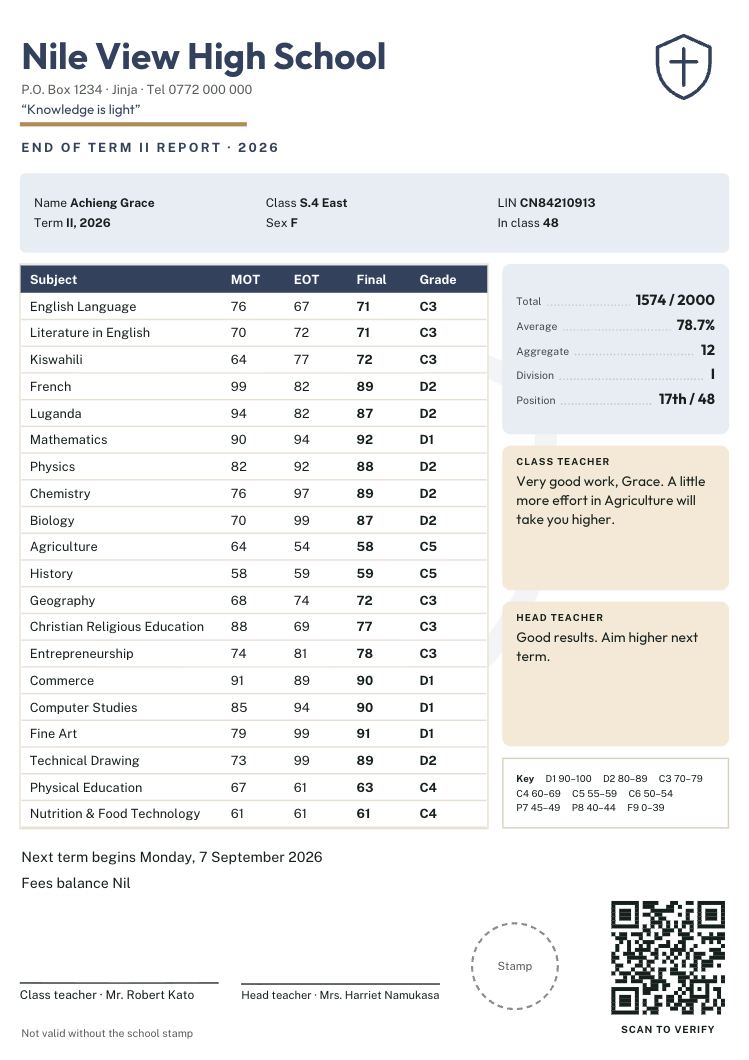
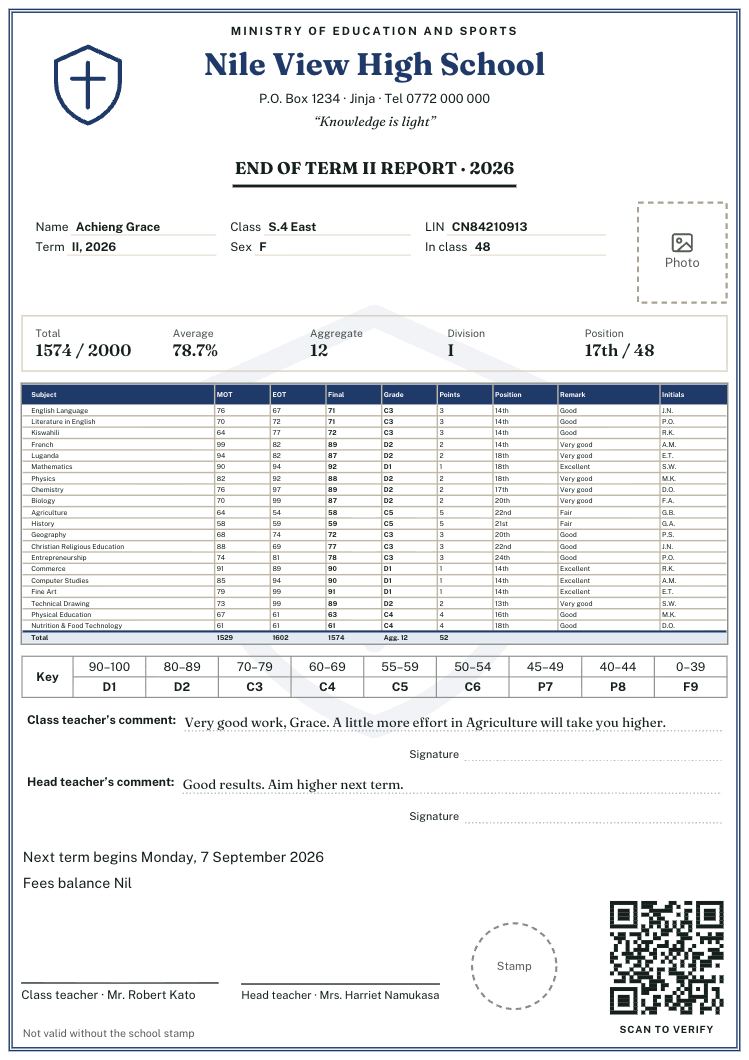
A secondary class can take 12 to 20 subjects. To keep every row on one A4 page:
- Use a compact table with smaller rows, and put the summary and comments beside it or below it.
- Leave out columns parents do not need. Each extra column makes every row tighter.
- Use the subject’s full name where there is room, and a clear short name where there is not.
- Print one test card with the most subjects and the longest name before printing the class.
Lower secondary on the new curriculum
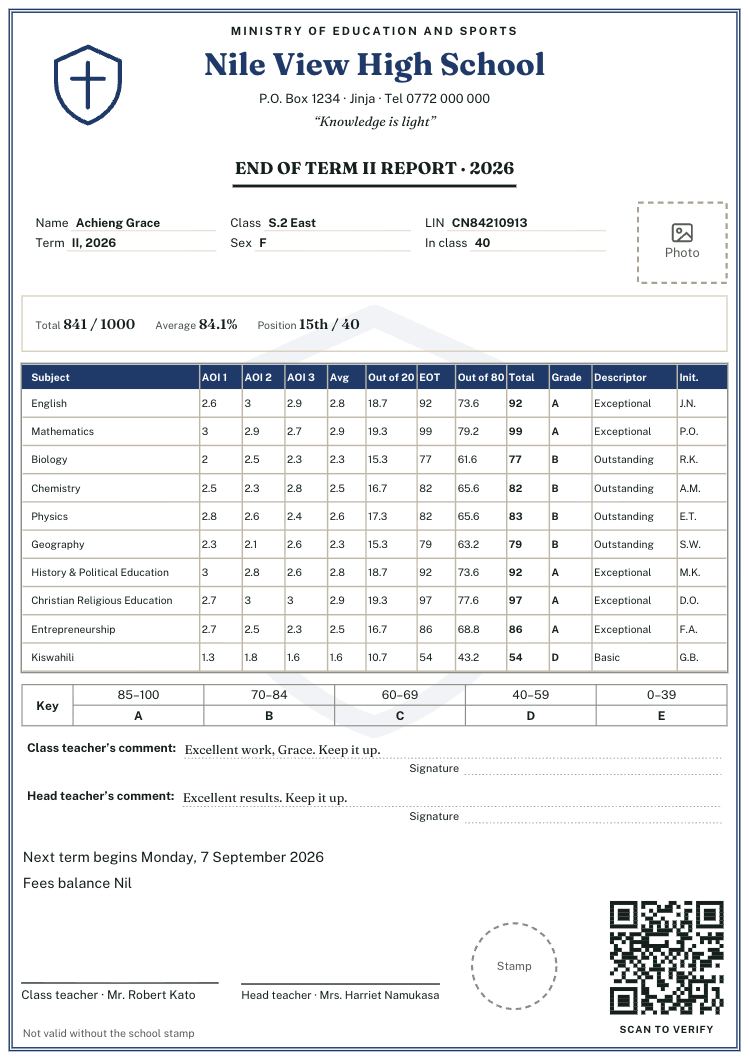
On the new lower secondary curriculum each subject has activities of integration (AOI), each scored 0 to 3. Their average gives the level and 20% of the final mark; the end-of-term exam gives the other 80%. Grades run from A to E with a descriptor, and there is no aggregate or division. The full working, with an example: new curriculum report cards →
A typical row: AOI 1, AOI 2, AOI 3, average, out of 20, end of term, out of 80, total, grade, descriptor and the teacher’s initials.
D1 to F9 grades and the best 8
Schools that grade secondary subjects from D1 to F9 usually add up the points of the best eight subjects for the aggregate, and set divisions from it: for example Division I from 8 to 32 points. Use your school’s own bands and ranges. How aggregates and divisions work →
A-level (S.5 and S.6)
A-level learners take principal subjects and subsidiary subjects. A-level cards usually show each paper’s marks, the subject grade, and whether the subsidiary subjects were passed, with a combined total of points. Because the rules differ between schools, set your own grades and points for A-level classes rather than using primary or O-level bands.
What else secondary parents look for
- Position in class and in the stream, where your school ranks learners.
- Each subject’s position, which some schools show beside the grade.
- Conduct, clubs and sports, often as a small table of words. Adding skills and co-curricular activities →
- House and boarding details, where they apply.
Questions schools ask
Does the new curriculum card have an aggregate?
No. New curriculum subjects are graded from A to E with a descriptor. There is no aggregate or division.
Can one school use different grading for O-level and A-level?
Yes. Grading is set for each level, so S.1 to S.4 and S.5 to S.6 can each have their own grades, points and rules.
Twenty subjects, one clean page
Report Card Studio fits every subject on one A4 card, works out grades, totals and positions, and supports the new curriculum’s activities and A to E grades. Free until you print.
Questions? Call or WhatsApp 0784 150 327, or email [email protected].